Impact Factor
Call For Paper
Volume 12 Issue 07
July 2026
Download Paper Format
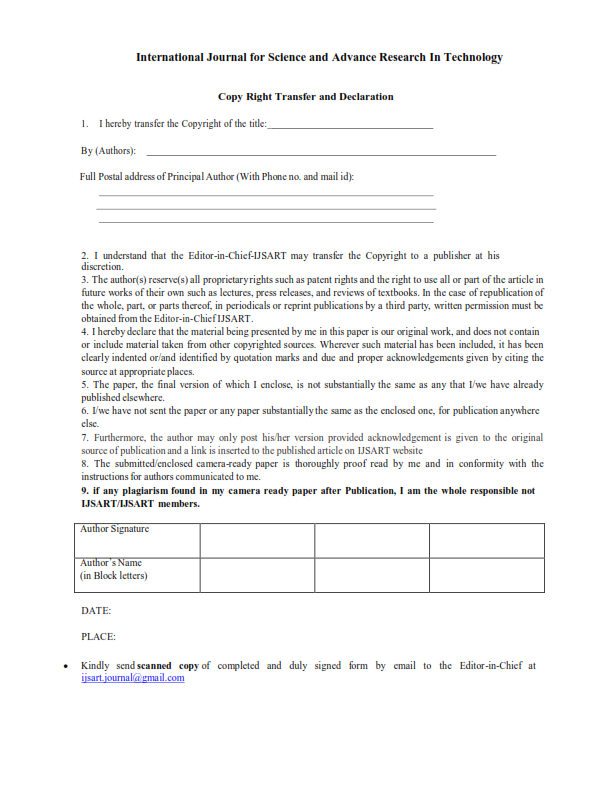
Copyright Form

Author(s)
Abstract
Illegal Wildlife Poaching Remains One Of The Most Critical Threats To Biodiversity Conservation, Leading To Ecological Imbalance, Species Extinction, And Economic Loss In Protected Reserves. Traditional Anti-poaching Strategies Rely Heavily On Manual Patrolling And Reactive Response Mechanisms, Which Are Inefficient In Large And Geographically Complex Forest Areas. There Is A Pressing Need For Intelligent, Data-driven Systems Capable Of Predicting High-risk Zones Before Poaching Incidents Occur. This Paper Presents WildGuard AI, A Wildlife Vulnerability Intelligence Engine Designed To Predict Poaching Risk Levels Across Protected Forest Zones Using Machine Learning Techniques. The Proposed System Utilizes Spatial, Environmental, And Historical Incident Data To Classify Forest Grids Into Low, Medium, And High-risk Categories. By Dividing Protected Reserves Into Structured 1 Km² Grids And Applying Supervised Learning Algorithms Such As Random Forest And Gradient Boosting, The System Generates Predictive Risk Heatmaps To Assist Forest Authorities In Strategic Patrol Deployment. The System Is Implemented Using Python, Flask Framework, And A Relational Database For Structured Storage Of Grid-level Intelligence Data. A Web-based Dashboard Visualizes Predicted Risk Zones, Patrol Allocation Data, And Vulnerability Metrics. Experimental Evaluation Demonstrates Reliable Classification Performance And Operational Feasibility. WildGuard AI Contributes Toward Proactive Conservation Strategies, Optimized Resource Allocation, And Technology-driven Wildlife Protection.
Keywords
Paper ID
IJSARTV12I3104633
Publication Date
March 3, 2026
Research Area
Artificial Intelligence And Machine Learning For Wildlife Conservation