Impact Factor
Call For Paper
Volume 12 Issue 09
September 2026
Download Paper Format
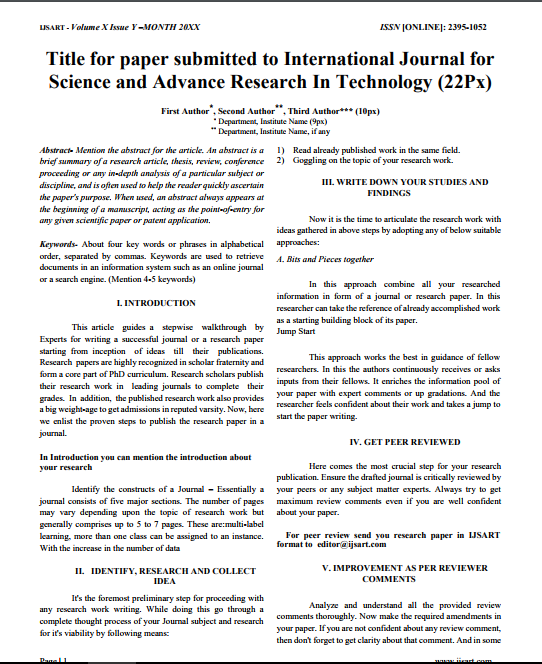
Copyright Form

Author(s)
Abstract
Industrial Wastewater, Especially From Textile Industries, Is Loaded With Harmful Contaminants Like Methylene Blue Dye And Lead (Pb²⁺) Ions, Which Can Seriously Threaten Water Quality And Aquatic Life. Traditional Treatment Methods, Such As Chemical Precipitation And Membrane Filtration, Tend To Be Costly And Often Create Secondary Pollutants. As A More Sustainable Option, Biosorption Using Affordable, Eco-friendly Adsorbents Has Gained Traction For Its Effectiveness. In Our Study, OPAC Showed Better Adsorption Efficiency Compared To CGAC, Likely Due To Its Larger Surface Area (867.5 M²/g Vs. 812.3 M²/g) And Higher Porosity. The Adsorption Process Was Driven By Electrostatic Interactions, Pore Diffusion, And Surface Complexation. These Results Underscore OPAC And CGAC As Promising, Cost-effective Adsorbents, Providing A Practical Solution For Treating Industrial Wastewater. Future Research Should Aim At Adsorbent Regeneration And Scaling Up For Better Environmental Sustainability.
Keywords
Paper ID
IJSARTV11I4103017
Publication Date
April 7, 2025
Research Area
Civil Engineering