Impact Factor
Call For Paper
Volume 12 Issue 09
September 2026
Download Paper Format
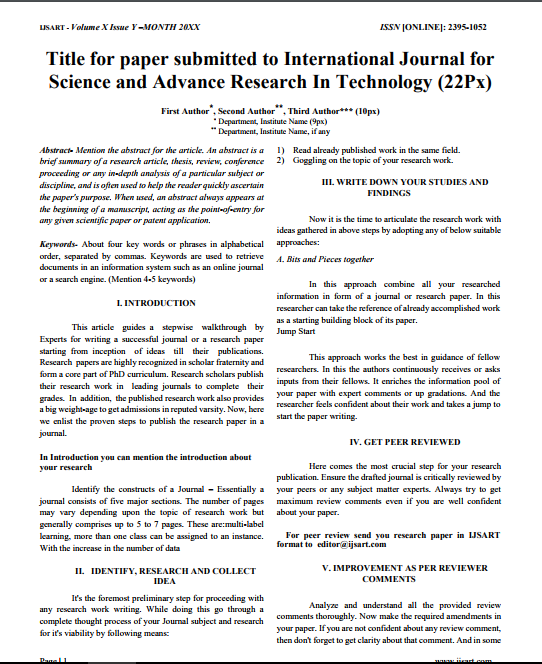
Copyright Form

Author(s)
Abstract
The National Education Policy (NEP) 2020 Introduces A Transformative Vision For Mathematics Education In India, Emphasizing Conceptual Understanding, Experiential Learning, And The Integration Of Technology. It Moves Away From Rote Memorization And Prioritizes Student-centered Pedagogies That Foster Logical Reasoning, Problem-solving, And Critical Thinking. This Paper Explores Various Teaching Strategies Proposed Under NEP-2020, Including Play-based Learning, The Use Of Mother Tongue, Flipped Classrooms, And Multiple Representations. It Also Highlights The Integration Of Tools Like GeoGebra, MATLAB, And Maxima To Enhance Mathematical Learning. Moreover, The Mathematics Holds A Central Role In Developing Cognitive And Analytical Abilities Among Learners. In Recognition Of This, The National Education Policy (NEP) 2020 Introduces A Framework Designed To Make Mathematics Education More Inclusive, Engaging, And Applicable To Real-life Contexts. The Policy Acknowledges The Cognitive Processes Of Learners, Especially Young Children, And Recommends Pedagogies That Support Learning Through Experience, Conceptual Understanding, And Metacognition. Rather Than Emphasizing Rote Memorization, NEP-2020 Encourages An Educational Shift Toward Critical Thinking, Logical Reasoning, And Independent Learning. Teachers Are Viewed As Key Document Reviews Major Reforms Such As The Shift To A 5+3+3+4 Curricular Structure, The Establishment Of PARAKH, And Efforts Like RAA And NBHM Aimed At Supporting Mathematics Education Nationwide. The Goal Is To Create An Inclusive, Flexible, And Engaging Learning Environment For All Students Across Different Socio-economic Backgrounds.
Keywords
Paper ID
IJSARTV11I8103961
Publication Date
August 9, 2025
Research Area
Education