Impact Factor
Call For Paper
Volume 12 Issue 09
September 2026
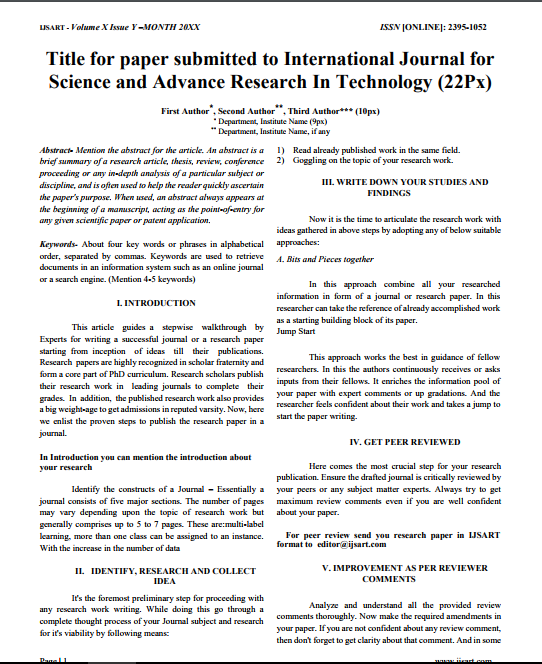
Download Paper Format
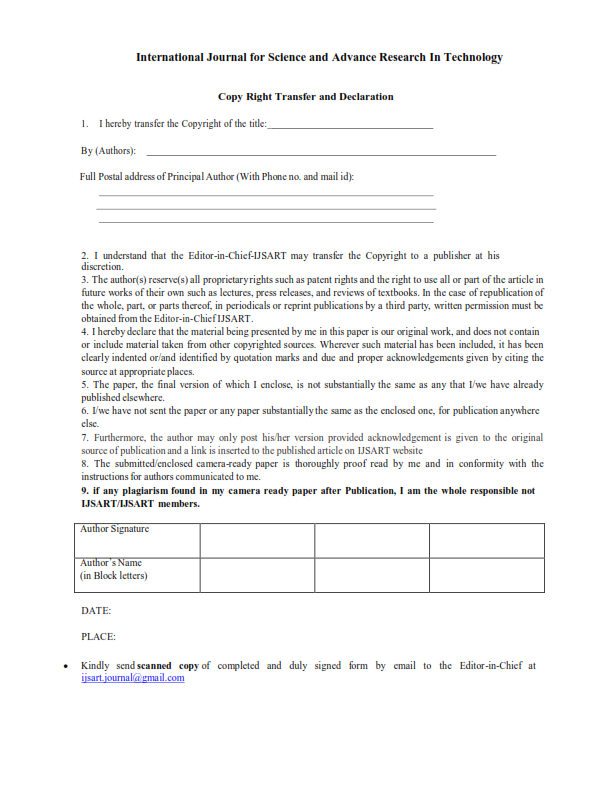
Copyright Form

Author(s)
Abstract
People Living With Complete Or Partial Paralysis Are Unable To Speak Or Generate Significant Body Movements, Leaving Them Entirely Reliant On The Constant Presence Of Attendants To Address Even The Most Basic Needs. Delays In Response — Whether Due To Caregiver Unavailability Or Communication Barriers — Can Escalate Minor Discomforts Into Medical Emergencies. The Goal Of This Project Is To Develop A Low-cost, Embedded System-based Solution That Restores A Degree Of Communicative Autonomy To Such Patients By Converting Residual Hand Movements Into Intelligible Messages That Can Be Delivered Both Locally And Over The Internet. A Wearable Transmitter Unit Worn On The Patient's Wrist Houses An MPU-6050 Inertial Measurement Unit. When The Patient Tilts Or Rotates The Hand, The Sensor Captures Six-axis Motion Data That An Onboard ATmega328P Microcontroller Interprets Against A Library Of Pre-mapped Gesture Patterns. Each Recognised Pattern Triggers The Transmission Of A Coded Signal Over A 433 MHz Radio-frequency (RF) Link To A Corresponding Receiver Unit Placed At The Nursing Station Or Caregiver's Location. Healthcare Personnel And Family Members With Authorised Access Can Therefore Monitor The Patient's Requests And Alerts In Real Time From Any Internet-connected Device, Regardless Of Physical Proximity. Bench Testing Across 250 Gesture Trials Yielded An Average Recognition Accuracy Of 94.4 %, An RF Link Reliability Of 98.2 %, And An End-to-end Cloud Notification Latency Below One Second On A Standard Broadband Connection. The System Is Portable, Power-efficient, And Built Entirely From Commercially Available, Off-the-shelf Components, Making It Readily Replicable In Resource-constrained Clinical And Home-care Settings.
Keywords
Paper ID
IJSARTV12I4105012
Publication Date
April 15, 2026
Research Area
Electronics And Communication Engineering