Impact Factor
Call For Paper
Volume 12 Issue 07
July 2026
Download Paper Format
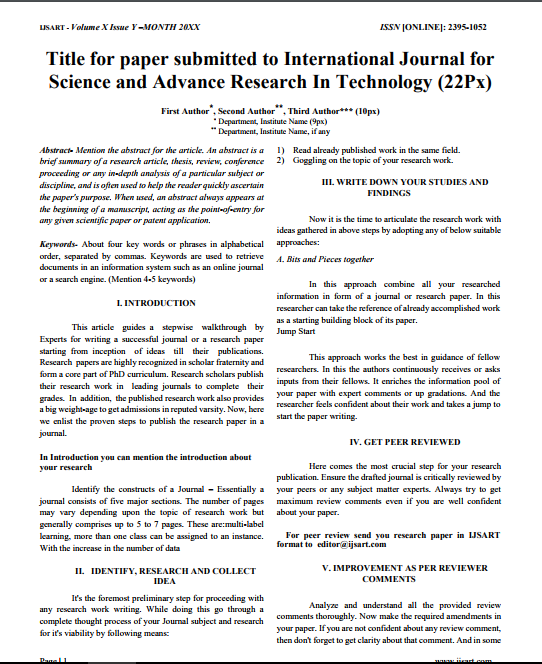
Copyright Form
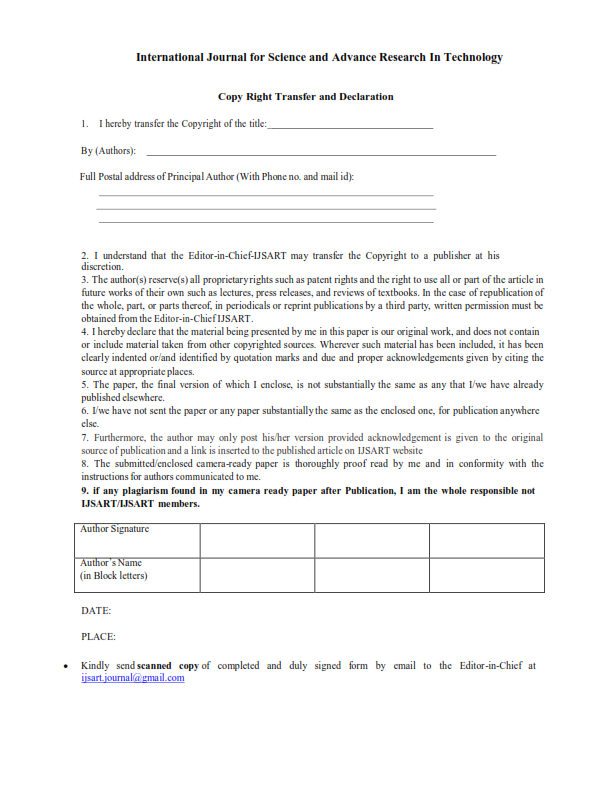

Author(s)
Abstract
The Growing Volume Of Unsolicited And Deceptive SMS Messages Poses A Critical Threat To Mobile Users, Necessitating The Development Of Accurate And Resilient Spam Detection Systems. While Machine Learning (ML)-based Models Have Been Widely Employed To Classify SMS Messages As Spam Or Ham, Most Existing Methods Are Evaluated Only On Clean, Unperturbed Datasets. This Paper Proposes A Random Forest (RF)-based SMS Spam Detection Model Enhanced With TF-IDF Feature Representation And Rigorously Evaluates Its Robustness Against Adversarial Message Manipulations Such As Synonym Substitution, Token Insertion, And Character Obfuscation. The Model Is Trained And Tested On The UCI SMS Spam Collection Dataset, With Adversarial Samples Generated To Simulate Real-world Evasion Attempts. Experimental Results Demonstrate That The Proposed RF Model Achieves An Accuracy Of 97.79%, Significantly Outperforming Several Benchmark Models Reported In The Literature, Even Under Adversarial Conditions. A Detailed Comparison With Prior Studies Highlights The Model’s Superior Robustness And Practicality For Deployment In SMS Filtering Systems. The Work Underscores The Importance Of Adversarial Evaluation And Paves The Way For More Resilient Spam Detection Frameworks.
Keywords
Paper ID
IJSARTV11I10104099
Publication Date
October 13, 2025
Research Area
SMS Spam Filtering Under Adversarial Conditions Using Random Forests