Impact Factor
Call For Paper
Volume 12 Issue 07
July 2026
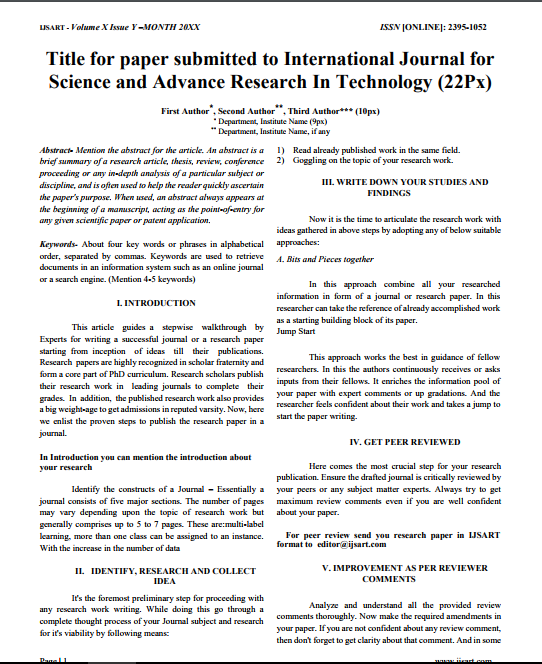
Download Paper Format
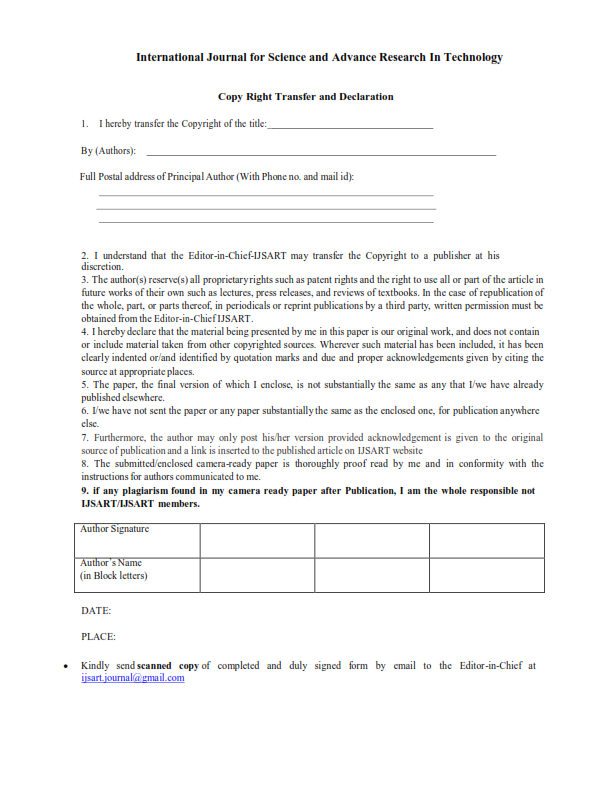
Copyright Form

Author(s)
Abstract
Heart Disease Is One Of The Leading Causes Of Mortality Worldwide, Making Early Risk Prediction Essential For Preventive Healthcare. Machine Learning (ML) Has Become An Effective Tool For Identifying Hidden Patterns In Medical Data To Support Clinical Decision-making. This Research Focuses On Developing A Heart Disease Prediction System Using Machine Learning Algorithms Such As Logistic Regression, Random Forest, Support Vector Machine (SVM), And K-Nearest Neighbors (KNN). The Dataset Includes Key Clinical Parameters Such As Age, Cholesterol Levels, Blood Pressure, Chest Pain Type, And ECG Results. Performance Evaluation Is Carried Out Using Accuracy, Precision, Recall, And F1-score. Among The Models Tested, The Random Forest Classifier Achieved The Highest Accuracy, Demonstrating That ML-based Systems Can Significantly Improve Early Detection And Reduce Risk Through Timely MedicalHeart Disease Remains One Of The Most Life-threatening And Widely Spread Medical Conditions Across The Globe, Contributing To A Significant Percentage Of Deaths Each Year. Early Identification Of Individuals Who Are At High Risk Can Drastically Reduce Mortality Through Timely Treatment And Lifestyle Modifications. However, Conventional Diagnostic Methods Depend Heavily On Clinical Expertise And Manual Interpretation, Which May Lead To Inconsistent Results. In Recent Years, Machine Learning (ML) Has Emerged As A Powerful Analytical Technique Capable Of Learning Patterns From Medical Data And Providing Reliable Predictive Insights.This Study Aims To Design And Evaluate An Intelligent Heart Disease Prediction Model Using Multiple Machine Learning Algorithms, Including Logistic Regression, Support Vector Machine (SVM), Random Forest, And K-Nearest Neighbors (KNN). The System Analyzes Crucial Health Indicators Such As Age, Blood Pressure, Cholesterol Level, Chest Pain Type, Blood Sugar, And ECG Readings To Determine The Probability Of Heart Disease In A Patient. Performance Metrics Such As Accuracy, Sensitivity, Specificity, Precision, And F1-score Are Utilized To Identify The Best-performing Algorithm Intervention.
Keywords
Paper ID
IJSARTV12I4105142
Publication Date
April 25, 2026
Research Area
Biomedical