Impact Factor
Call For Paper
Volume 12 Issue 09
September 2026
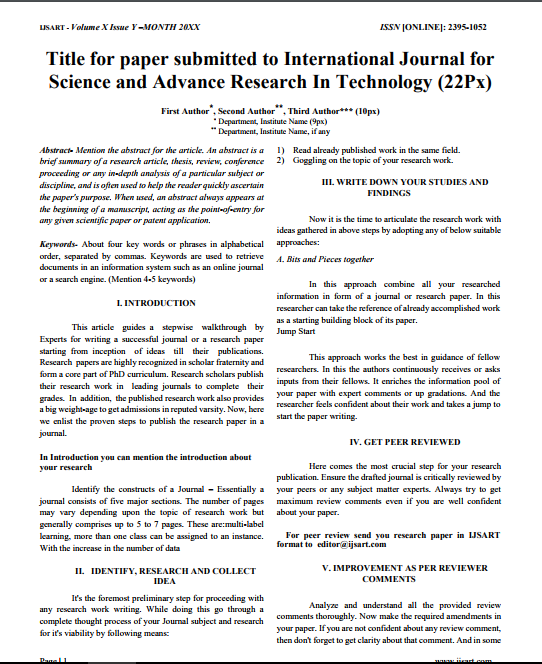
Download Paper Format
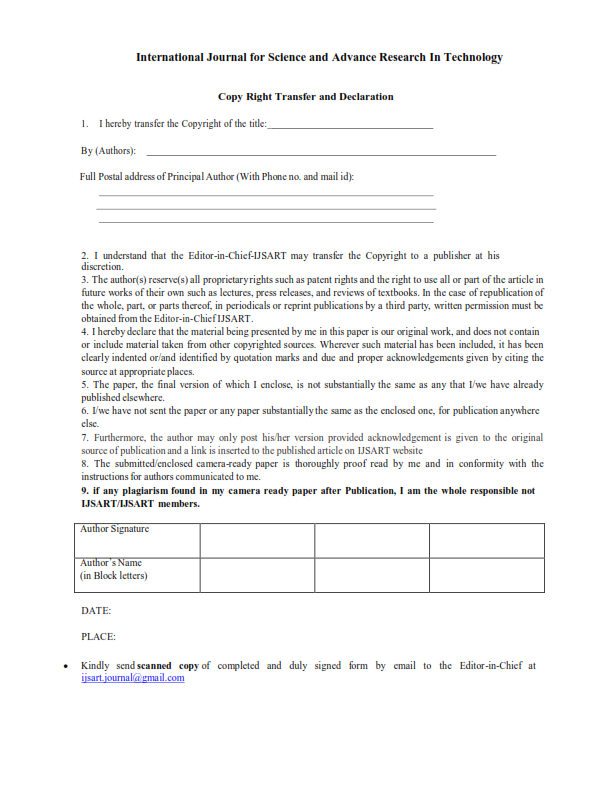
Copyright Form

Author(s)
Abstract
The Increasing Contamination Of Water Bodies By Synthetic Dyes Poses Severe Environmental And Health Hazards. Dye Pollution, Primarily From Textile And Dyeing Industries, Has Become A Critical Environmental Issue Due To Its Significant Impact On Water Bodies And Ecosystems. The Discharge Of Untreated Dye-laden Wastewater Deteriorates Water Quality, Disrupts Aquatic Life, And Introduces Toxic, Non-biodegradable Substances That Persist In The Environment. Many Synthetic Dyes Are Harmful To Humans, Causing Allergies, Organ Damage, And Even Cancer. Addressing This Problem Is Vital For Sustainable Water Management. Water Pollution Due To Industrial Effluents Containing Synthetic Dyes Is A Significant Environmental Challenge, Affecting Aquatic Ecosystems And Human Health. This Study Investigates The Adsorption Potential Of Rice Husk And Apricot Stones As Cost-effective And Sustainable Adsorbents For The Removal Of Methylene Blue (MB) Dye From Wastewater. A Systematic Series Of Batch Adsorption Experiments Were Conducted To Evaluate The Impact Of Key Parameters, Including Adsorbent Dosage, Contact Time, PH, Temperature, Initial Dye Concentration, And Agitation Speed, On Adsorption Efficiency. Experimental Results Revealed That Apricot Stones Demonstrated Superior Adsorption Capacity, Achieving A Maximum Removal Efficiency Of 95.2%, While Rice Husk Reached 92.1% Under Optimal Conditions. The Adsorption Process Followed Pseudo-second-order Kinetics, Confirming That Chemisorption Was The Dominant Mechanism. The Equilibrium Data Were Best Described By The Langmuir Isotherm Model, Indicating Monolayer Adsorption On A Homogenous Surface. Additionally, Both Adsorbents Exhibited High Regeneration Potential, Retaining Over 80% Of Their Initial Adsorption Capacity After Five Reuse Cycles, Making Them Viable For Multiple Uses In Wastewater Treatment. The Study Further Demonstrated A Significant Reduction In Key Water Quality Parameters, Including Chemical Oxygen Demand (COD), Biological Oxygen Demand (BOD), Total Dissolved Solids (TDS), And Turbidity, Confirming The Effectiveness Of These Natural Adsorbents In Improving Wastewater Quality. These Findings Establish That Rice Husk And Apricot Stones Are Efficient, Environmentally Friendly, And Economically Feasible Alternatives To Conventional Wastewater Treatment Methods. Their Application In Large-scale Water Purification Systems Could Contribute To Sustainable Water Management And Pollution Control.
Keywords
Paper ID
IJSARTV11I5103573
Publication Date
May 15, 2025
Research Area
Civil Engineering