Impact Factor
Call For Paper
Volume 12 Issue 09
September 2026
Download Paper Format
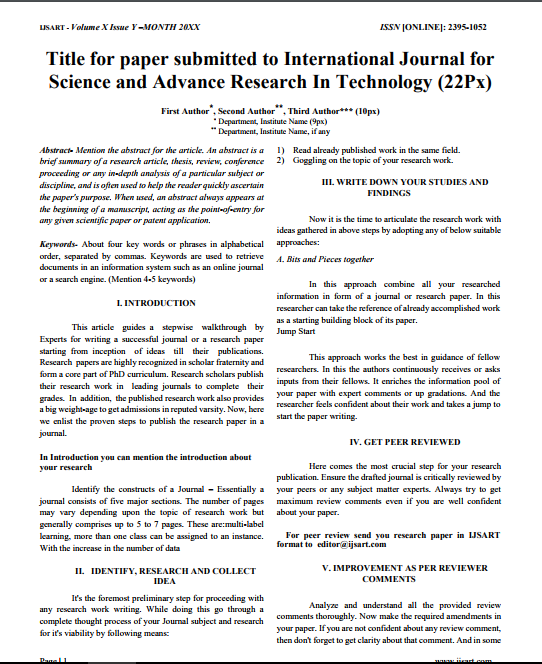
Copyright Form

Author(s)
Abstract
The Increasing Demand For High-speed Aircraft And Missile Systems Has Led To The Development Of Propulsion Systems Capable Of Operating Efficiently At Supersonic Speeds. This Study Focuses On The Design And Computational Analysis Of A Ramjet Engine Inlet For Supersonic Flight Applications, Specifically Examining The Influence Of Cone Angle On Pressure Recovery Performance. Three Inlet Cone Angles (43°, 44°, And 45°) Were Modeled Using SolidWorks And Subjected To Cold-flow Analysis In ANSYS Fluent At Mach Numbers 2, 2.5, And 3. The K-epsilon Turbulence Model Was Employed With Density-based Solver Settings Under Steady-state Conditions. Results Indicate That A 45° Cone Angle Achieves Maximum Pressure Recovery At Mach 3, Producing An Exit Pressure Of 1,585,917.50 Pa And Generating A Shock-train Configuration Favorable For Pre-combustion Conditions. The 44° Cone Angle Demonstrates The Highest Absolute Exit Pressure (2,806,599.25 Pa) At Mach 3 But Requires Supercritical Inlet Conditions. The Findings Provide Design Guidance For Artillery Ramjet Inlet Geometry Optimization And Contribute To The Broader Understanding Of Supersonic Air-breathing Propulsion Systems.
Keywords
Paper ID
IJSARTV12I4105201
Publication Date
April 29, 2026
Research Area
Aeronautical Engineering