Impact Factor
Call For Paper
Volume 12 Issue 09
September 2026
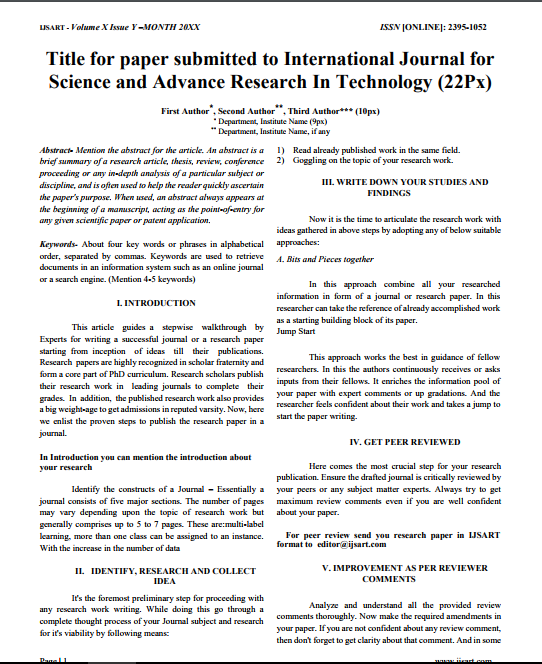
Download Paper Format
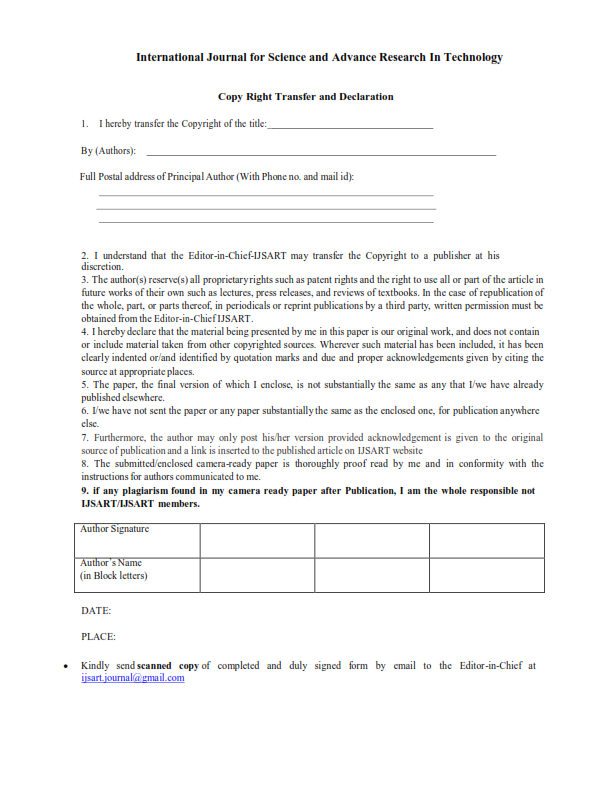
Copyright Form

Author(s)
Abstract
Ramanujan's Tau Function, τ(n), Defined By The Fourier Coefficients Of The Modular Discriminant Δ(q), Is A Cornerstone In Analytic Number Theory. While Its Fundamental Multiplicative And Recursive Properties Are Well-established, Deeper Questions Concerning Its Statistical Distribution, Novel Congruence Relations, And Connections With Special Number Sequences Remain Significant Open Challenges. This Paper Presents A Comprehensive Investigation Addressing These Problems. We Pioneer The Use Of A Cutting-edge Methodology That Combines The Principles Of Classical Number Theory With Python-based Data Analysis And Deep Learning. Through Extensive Empirical Analysis Of τ(n) Up To 107, We Quantify Its Statistical Distribution And Confirm Its Consistency With The Sato-Tate Theorem. We Present A Systematic Search For New Congruence Relations And Explore Its Behavior With Special Number Sequences Like Fibonacci Numbers. Crucially, A Deep Learning Neural Network Is Utilized To Discover And Provide Strong Empirical Support For A New Mathematical Conjecture On The Refined Growth Law Of τ(n) For Squarefree Numbers. This Work Demonstrates The Powerful Synergy Of Classical Number Theory With Modern Computational Methods, Offering Substantial New Insights And Paving The Way For Future Research.
Keywords
Paper ID
IJSARTV11I7103926
Publication Date
July 26, 2025
Research Area
MATHS AND ENGINEERING