Impact Factor
Call For Paper
Volume 12 Issue 09
September 2026
Download Paper Format
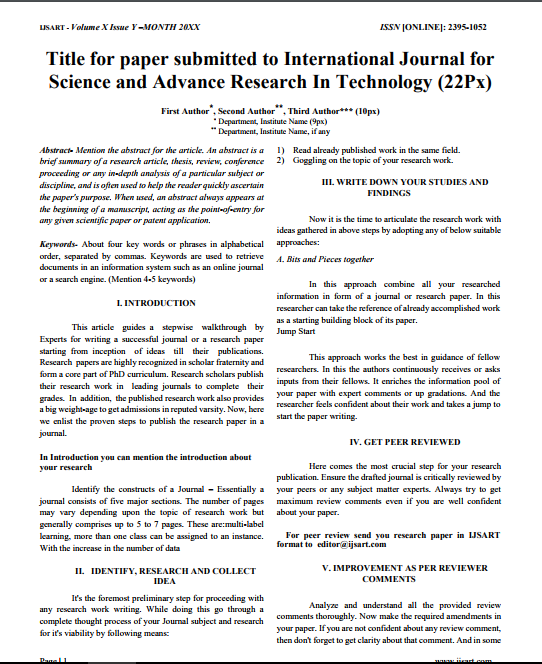
Copyright Form
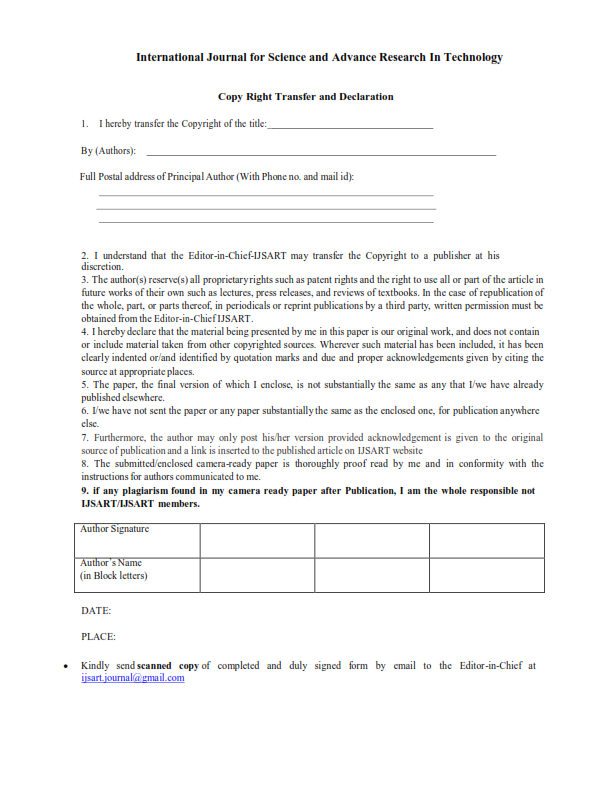

Author(s)
Abstract
In This Paper, We Explore The Potential Of Combining Environmental Control Systems, Internet Of Things (IoT) Sensors, And Adaptive Computervision Algorithms To Reduce Labor Demands In Organic Farming. Growth Conditions Can Be Optimized Without The Use Of Chemicals By Utilizing Controlled-environment Techniques, Such As Controlling Humidity And Temperature And Lighting With Halogen Or LED Lights. Up To 95% Efficiency Is Achieved Through Automated Water Supply With Precision Irrigation Using IoT-enabled Sprinklers. Closed Greenhouses Stop Pests From Entering, Therefore No Pesticides Are Used. We Describe How Deep-learning Classifiers And OpenCV-based Image Analysis Allow For Automated Disease Identification And Crop Health Monitoring With Accuracies Higher Than 90%. Recent Studies Have Shown That There Is Potential For Labor Reductions Of 50–70%, Water Savings Of Up To 40%, And Yield Gains Of 15–30%. We Go Over System Topologies, Implementation Difficulties, And Financial Trade-offs. We Also Suggest Ways That Future Smart Organic Farms Can Incorporate Scalable Data Infrastructures And Renewable Energy.
Keywords
Paper ID
IJSARTV11I4103416
Publication Date
April 30, 2025
Research Area
Artificial Intelligence And Data Science