Impact Factor
Call For Paper
Volume 12 Issue 07
July 2026
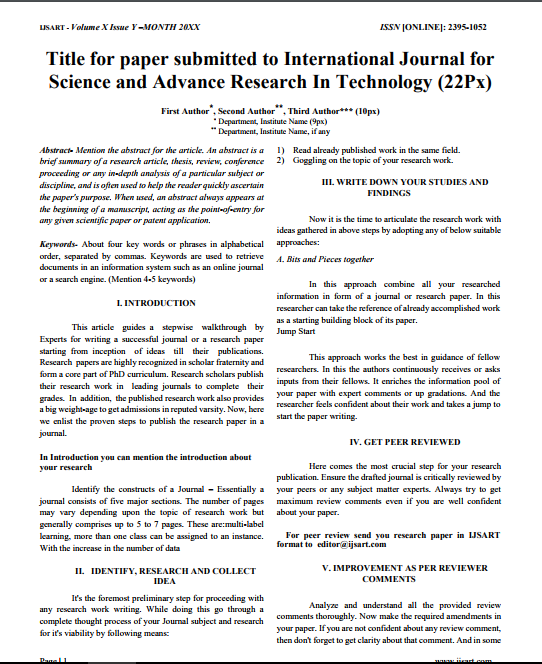
Download Paper Format
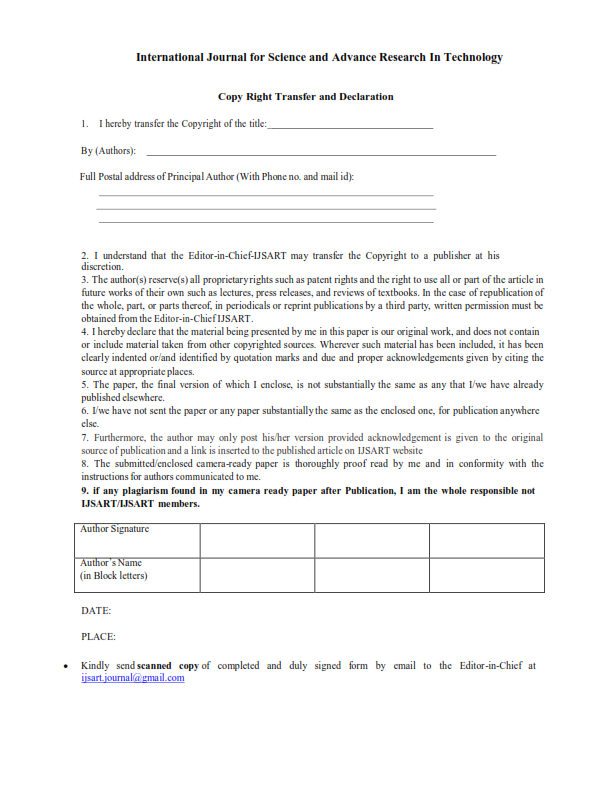
Copyright Form

Author(s)
Abstract
Federated Learning (FL) Has Emerged As A Critical Paradigm For Collaborative Model Training In Privacy-constrained Domains, Particularly In Healthcare. This Study Presents A Comprehensive FedAvg-based Framework For Brain Tumor Detection From Magnetic Resonance Imaging (MRI) Scans, Employing Three Geographically Distributed Institutions As Local Clients And A Central Server For Global Aggregation. Each Client Trains An Identical Convolutional Neural Network (CNN) Model Using Institution-specific Subsets Of The BraTS 2020 Dataset, With Preprocessing Steps Including Skull Stripping, Intensity Normalization, And Uniform Resizing To 224×224 Pixels. Over 50 Communication Rounds, Local Models Perform Two Epochs Of Stochastic Gradient Descent Per Round, Contributing Data-weighted Parameter Updates To The Server. The Global Model, Initialized With Xavier Initialization, Converges Rapidly, Achieving A Validation Accuracy Of 96.2% By Round 30 And Stabilizing Between 95% And 97% By The Final Round. Comparative Analysis Against A Centralized Baseline—trained On Pooled Data—shows The Federated Framework Attains 96.5% Accuracy, Indicating Negligible Performance Degradation Despite Strict Privacy Constraints. Additional Evaluation Metrics Include Precision (95.8%), Recall (96.0%), And F1-score (95.9%), Demonstrating Balanced Classification Performance. Resource Utilization Metrics Reveal That Federated Training Incurs Only A 12% Increase In Training Time Relative To Centralized Training, Underscoring The Framework’s Efficiency. The Proposed Methodology Preserves Patient Privacy By Keeping Raw MRI Data Localized While Delivering Near-centralized Performance, Making It A Viable Solution For Multi-institutional Medical Imaging Collaborations. This Work Lays The Groundwork For Future Enhancements, Such As Integrating Secure Aggregation, Differential Privacy, And Personalized Model Fine-tuning, To Further Strengthen Privacy Guarantees And Model Personalization.
Keywords
Paper ID
IJSARTV11I5103478
Publication Date
May 6, 2025
Research Area
CSE