Impact Factor
Call For Paper
Volume 12 Issue 07
July 2026
Download Paper Format
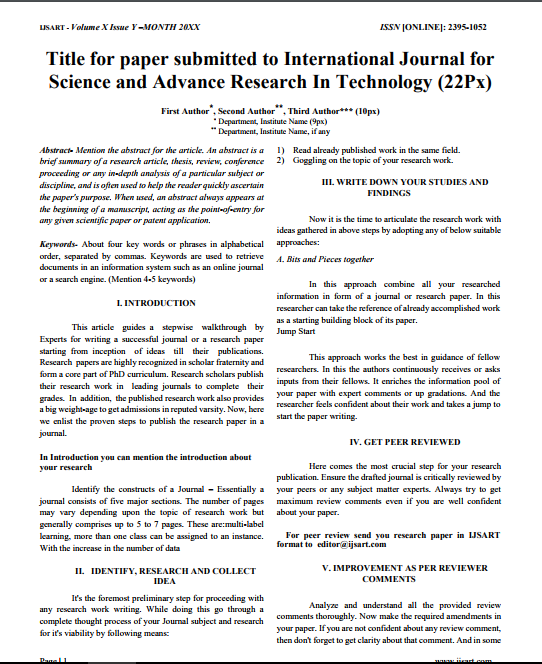
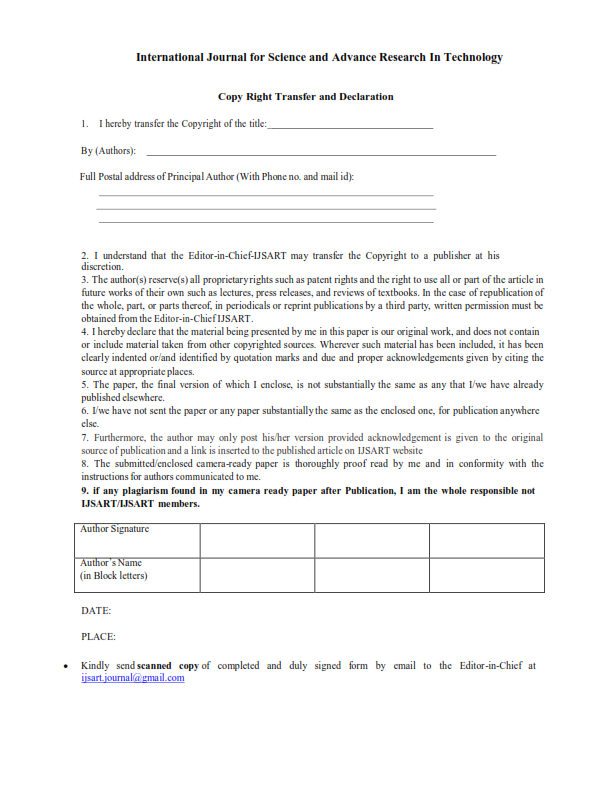
Copyright Form

Author(s)
Abstract
The Pervasive Adoption Of Digital Platforms Has Precipitated A Concomitant Escalation In Phishing Attacks, Wherein Malicious Uniform Resource Locators (URLs) Serve As The Primary Vector For Credential Theft, Financial Fraud, And Malware Dissemination. Conventional Detection Paradigms, Including Blacklist-based Filtering, Signature Matching, And Rule-based Heuristics, Are Demonstrably Insufficient Against Zero-day Attacks And Polymorphic Phishing Campaigns That Continuously Mutate To Evade Static Defenses. This Paper Presents An Integrated Framework For Real-time Malicious URL Detection Leveraging A Multi-layered Artificial Intelligence Architecture Comprising Logistic Regression (LR), Decision Trees (DT), Random Forest (RF), Support Vector Machines (SVM), Convolutional Neural Networks (CNN), And Recurrent Neural Networks (RNN) With Long Short-Term Memory (LSTM) Cells. A Comprehensive Feature Engineering Pipeline Extracts URL-lexical, Domain-metadata, Content-structural, And Behavioral Attributes From Heterogeneous Data Sources Including Kaggle And PhishTank Repositories. The Proposed System Is Deployed Within A Django-based Full-stack Web Application Integrated With The VirusTotal API For Real-time Threat Intelligence Augmentation. A Secure Continuous Integration And Continuous Deployment (CI/CD) Pipeline Ensures Automated Testing, Vulnerability Assessment, And Deployment Integrity. Experimental Evaluation Demonstrates That Ensemble And Deep Learning Models Achieve Superior Classification Performance Across Accuracy, Precision, Recall, F1-score, And ROC-AUC Metrics Compared To Legacy Detection Methods. The System Addresses Identified Research Gaps Including Concept Drift Resilience, Dataset Imbalance, And Adversarial Robustness. Future Directions Encompass Transformer-based Architectures, Federated Learning, And Explainable AI (XAI) Integration.
Keywords
Paper ID
IJSARTV12I5105414
Publication Date
May 20, 2026
Research Area
Cyber Security